
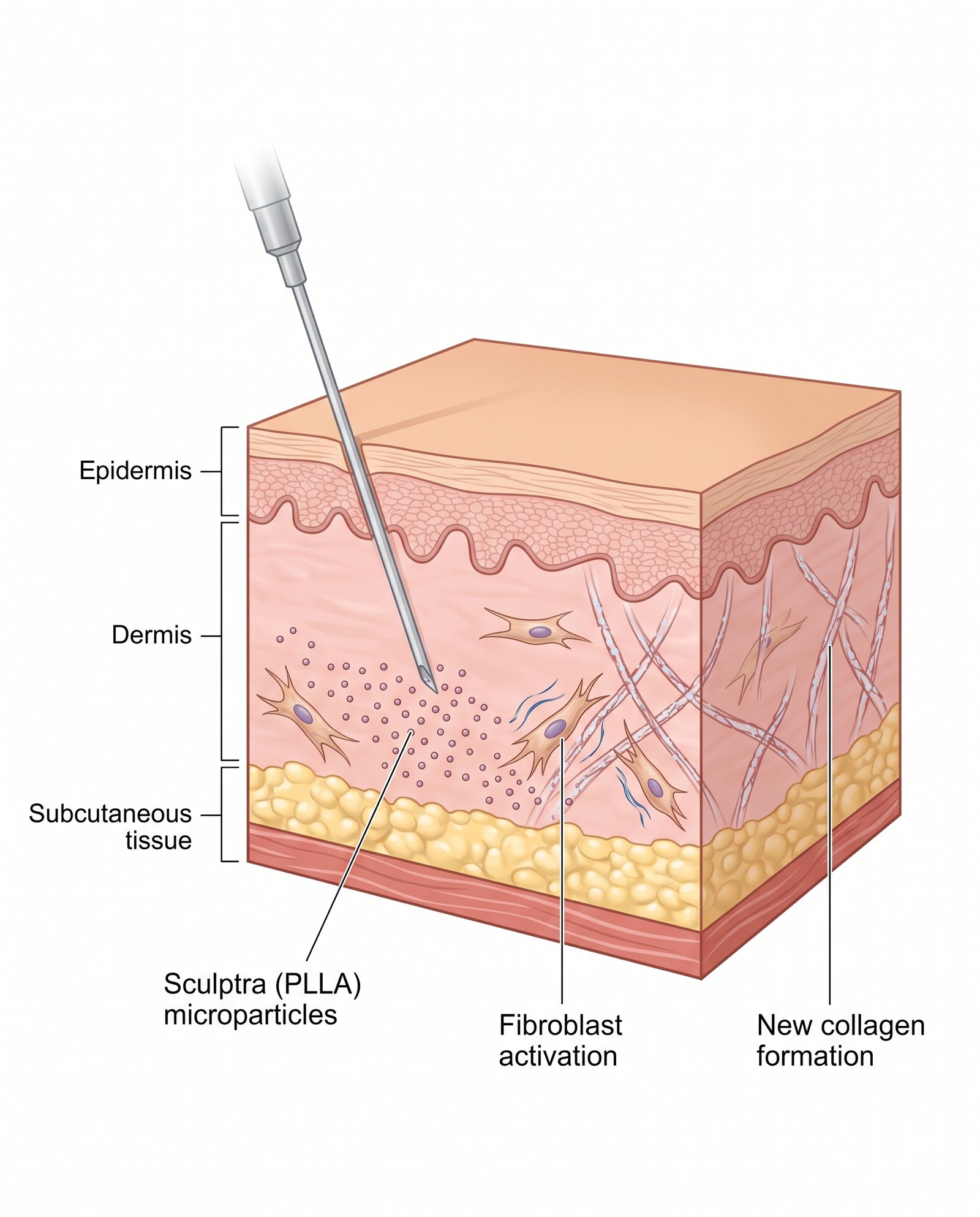
Sculptra does not fill a line. It asks your own fibroblasts to build type I collagen — thickening the skin itself, tightening laxity, softening vertical lines and heading off the thin, crepey texture that arrives later. It corrects volume, yes. But most of what it is doing is changing the quality of your skin.
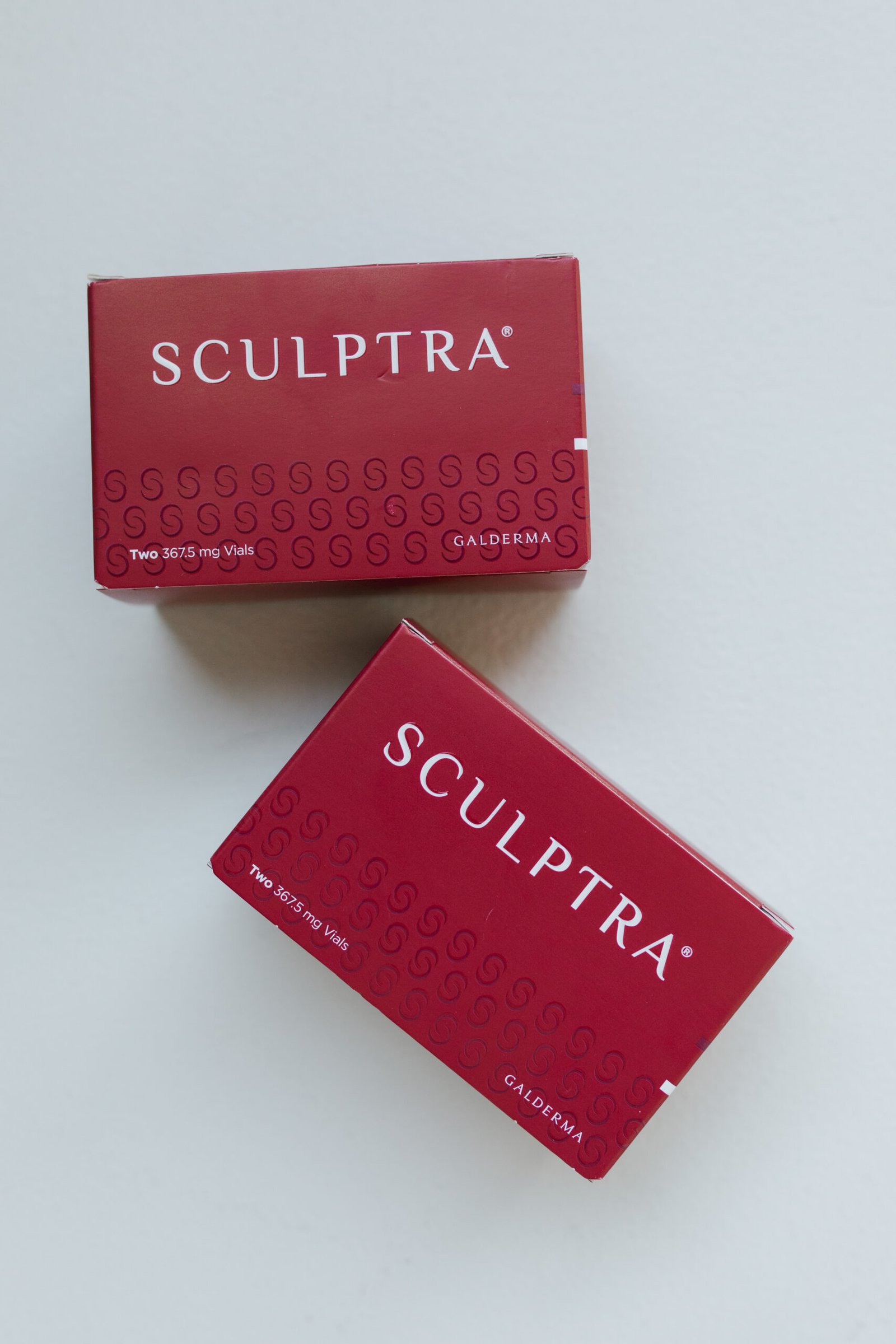
Injectable poly-L-lactic acid — a biodegradable polymer that provokes a controlled, self-limited healing response. Your fibroblasts do the building. The polymer itself is gone within roughly two to two and a half years; the collagen it prompted outlasts it.
Skin quality, first and foremost — thicker skin, less laxity, softer vertical lines, and the crepey thinning that follows if nothing is done. Diffuse volume loss across the midface, cheeks, temples and lateral jawline is the second job, not the only one.
Not for a single line. Not for lips, tear troughs or the glabella. Not for a face whose main problem is heaviness rather than emptiness.
Most people start with a three-vial course — commonly two at the first session and the third at three to six months — then maintain with one visit a year, one to two vials depending on skin quality, age and hormone status.
Sessions are four to six weeks apart minimum, and we photograph before we add.
The eight questions we are asked most, each answered in a line or two. Open it if you want the short version before the long one.
Poly-L-lactic acid is a biodegradable polymer that has been used in dissolvable sutures for decades. Injected into the right plane, it does something a gel cannot: it provokes a mild, self-limited healing response, and the tissue rebuilds itself around it.
The sequence is well documented. Within the first month the microparticles are encapsulated by macrophages and giant cells. By around three months the inflammatory cells are receding and collagen fibres are being laid down — type III first, close to the particles, then type I collagen later, in the fibrous capsule around them, produced by activated fibroblasts. Between eight and twenty-four months the type I collagen increases significantly and cross-links.
Meanwhile the polymer is hydrolysed to lactic acid and metabolised. In one expert-consensus review, biopsies taken thirty months after the last treatment showed increased type I collagen content and no remaining PLLA microparticles. The scaffold leaves. The collagen stays. That is the whole idea.
Clinically that reads as better skin rather than more face. Denser dermis, so the skin is thicker to the touch. Better recoil where laxity has started. Vertical lines that soften because the tissue holding them has been rebuilt rather than propped up. And the thin, crepey, tissue-paper texture that follows collagen loss simply not arriving on schedule. Volume correction is part of what we are doing. It is not the larger part.
It is also why every part of the experience is different from filler. There is nothing to admire in the mirror on the way out. There is nothing to dissolve if you dislike it. And there is no honest way to know how much collagen you will build until we measure it — one volumetric study found a nine-fold spread in tissue response per vial between patients. That is the argument for starting low, not for starting big.
Different changes have different causes, and different answers. Pick whichever sounds most like what you see in the mirror.
Diffuse midface atrophy is the textbook indication. The deep medial cheek fat deflates first and most, which removes the platform everything above it was resting on. There is no single line to fill here, which is why filling lines never fixes it — the deficit is spread across a broad area, and a treatment that rebuilds tissue across a broad area is the one that matches it.
This is a starting point, not a diagnosis. Most people have more than one thing changing at once — which is exactly why we assess it in person, in consistent light, with photographs. If a biostimulator is not the answer for you, we will say so.
We would rather talk you out of a treatment than perform one that will not please you. Both lists are reviewed against your medical history and your consent form at your visit.
None of these guarantees a result. They make one more likely.
Some of these are absolute. Some just mean not yet, or not this.
Bring the full medication and supplement list, including the things you would not think to mention — blood thinners, anti-inflammatories, fish oil — and tell us about any filler already placed in the areas we are discussing.
Every timeframe below is an estimate for a typical patient, not a promise. Yours is confirmed at your visit.
Everything above is enough to decide whether to come in. If you want the biology, the comparison, or the honest safety data, they each have their own page.
Written for the woman who looked in the mirror at forty-three and saw someone she did not quite recognise. Bone, fat, skin and hormones, with the evidence.
The comparison everybody searches for, answered honestly: it is almost never either/or. Two biostimulators, two mechanisms, two different jobs.
The nodule question, answered with published numbers — and why the same product produced 0% at one study site and 79% at another.
Sculptra is a course of treatment built over months, not an appointment you book once. Everyone in Denver publishes a per-vial price; that is not the number you will actually pay. Here is the whole thing.
10% off when you purchase three vials or more. Most patients start with a three-vial course — $2,295 bought together rather than $2,550 — usually two at the first session and the third at three to six months.
Three vials: two at the first session, the third at three to six months, then one visit a year — one to two vials — as maintenance, paced to your skin quality, age and hormone status rather than to a calendar rule. Athletes, patients with a fast metabolism and patients on GLP-1 medications consistently need maintenance sooner.
Sculptra is also rarely the whole plan. Most comprehensive treatments combine it with Radiesse for structure on bone, and skin-quality work for the surface. Units are priced identically across both biostimulators, so a combined plan is costed on total units rather than on which product we reached for.
You will see a “one vial per decade of life” rule quoted widely. We do not dose that way. How much you need depends on how much volume has actually been lost and how much of the face we are treating — not on how many birthdays you have had.
What is quoted at your visit depends on how much volume has been lost and how much area we are treating. If we do not think Sculptra is right for you, we will tell you before you pay for anything.
Book a consultationPoly-L-lactic acid — a synthetic, biodegradable polymer from the same family used in dissolvable surgical sutures for decades. Each vial contains 150 mg of PLLA as freeze-dried microparticles, with sodium carboxymethylcellulose and mannitol as carriers. It is reconstituted with sterile water before use, usually with lidocaine added for comfort.
Not in the way people mean the word. A hyaluronic-acid filler is a gel that occupies space and holds water from the moment it is injected. Sculptra occupies almost no space; it provokes a controlled healing response that leads your own fibroblasts to lay down new collagen over the following months. The manufacturer's own labelling instructs injectors to undercorrect, precisely because the immediate appearance is the diluent rather than the product.
Because what you saw on the day was the sterile water the vial was mixed with. The approved labelling states this directly: injection-related swelling gives a false appearance of full correction, typically resolves in several hours to a few days, and results in the reappearance of the original contour deficiency. It is expected, it happens to everyone, and it is the single most common reason patients call in a panic on day three.
Nothing meaningful is visible in the first week. Fibroblast activation and early matrix deposition happen over roughly weeks two to six; collagen maturation and reorganisation over weeks six to sixteen. That is why we do not assess a result before twelve weeks and never re-treat sooner than four to six weeks. Anyone promising visible change in days is describing a different product.
Most patients start with a three-vial course — commonly two at the first session and a third at three to six months — then maintain with one visit a year, of one to two vials. The number is driven by how thin the skin has become, how much volume has been lost and how much surface area we are treating, not by your age. The widely repeated 'one vial per decade of life' rule is a marketing heuristic; it appears nowhere in the FDA labelling and we do not price treatment that way.
At Skin! it is $850 per vial, with 10% off when you purchase three vials or more. A typical starting course is three vials, $2,295 purchased together rather than $2,550. Maintenance is usually a single visit each year, of one to two vials. Most comprehensive plans combine Sculptra with Radiesse, which is priced identically, so a combined plan is costed on total units.
The FDA-approved labelling reports effects sustained up to 25 months in some patients. In the randomised study that supported the 2023 cheek-wrinkle indication, 76.9% of responders were still improved at 24 months. Claims of three to five years exceed the published data and we will not make them. Roughly two years, with maintenance, is the defensible answer.
It is FDA-approved, and the published complication rates depend overwhelmingly on how it is injected rather than on the product itself. In the manufacturer's own five-year surveillance study the papule and nodule rate ranged from 0% to 79.1% across investigational sites, for the same product under the same protocol. In contemporary practice with 8 to 10 millilitres of dilution and deep placement, the largest real-world dataset of 1,002 patients across 4,483 treatments reported 0.4%. Because that distinction matters so much, we published the full data, the technique that drives it, and our management protocol on a dedicated page.
No. Unlike hyaluronic-acid filler, which can be dissolved with hyaluronidase, there is no enzymatic agent that removes poly-L-lactic acid. Your body metabolises it over roughly two years. This is the genuine trade-off of a biostimulator, and it is the reason to choose the injector before you choose the product, and to start with fewer vials than you think you need.
It can, in the wrong candidate. Sculptra thickens tissue diffusely rather than sculpting a defined shape. In a genuinely atrophic face that is exactly what you want. In a face whose dominant problem is heaviness, jowling or descent, adding diffuse volume makes it read wider and heavier. This is a patient-selection question rather than a dosing one. If laxity rather than volume loss is your main issue, we will tell you that instead of selling you three vials.
Yes, for specific indications. It was approved in 2004 for facial fat loss in people with HIV, in 2009 for correction of shallow to deep nasolabial fold contour deficiencies and other facial wrinkles in immune-competent people, and in April 2023 for fine lines and wrinkles in the cheek region. Treatment of the temples, jawline, chin and any body area is off-label in the United States. Off-label use by a physician is legal and common, and we would rather say so than let you assume broader approval than exists. A body indication was granted in Europe in December 2025; that is a European approval, not an FDA one.
Anyone with a history of or susceptibility to keloid formation or hypertrophic scarring, hypersensitivity to poly-L-lactic acid, carboxymethylcellulose or mannitol, active infection or inflammation at the treatment site, or active autoimmune disease. It is not used in pregnancy or breastfeeding, and safety has not been established under eighteen. Beyond the label, we consider other treatments for patients whose dominant concern is laxity rather than volume, patients who need a result within three months, and patients in their twenties with no measurable atrophy who have been sold this as prevention.
The evidence base is thinner than it should be, because the pivotal trials were run in predominantly lighter-skinned populations. The one substantive paper on poly-L-lactic acid in Fitzpatrick IV to VI reports hyperpigmentation as a rare side effect, associated mainly with bruising and with faster injection rates, and reports no keloid formation in that cohort. Its recommendations map onto how we already work: place deeper than the superficial subcutaneous layer and avoid the deep dermis, inject slowly, use nerve blocks and anaesthetic that limits bruising, and space sessions further apart, since patients with skin of color often reach the desired correction in fewer sessions. We will tell you where that guidance is evidence and where it is experience.
Yes, and it usually is. Structural support from a biostimulator, a small amount of hyaluronic-acid filler where a defined correction is genuinely needed, neuromodulator for dynamic lines, and resurfacing or microneedling for the skin surface all address different problems. What we avoid is layering a space-occupying filler on top of a biostimulator that is still building volume, because the final sum then exceeds the plan.
We do not know, and anybody who tells you they do is overstating the evidence. The theoretical concern is that the fibrous tissue a biostimulator creates could complicate flap dissection. There is no strong published evidence either way, and surgeons disagree. What we can tell you is that the material itself is fully metabolised over roughly two years, and that if a lift is genuinely on your horizon, that is a conversation to have with the surgeon before you start a series with us.
Every biostimulator treatment is performed by a licensed medical professional, trained directly by Dr. Shyanie Kumar, MD and working under her direct physician oversight. Because the published complication rate varies far more with technique than with the product, we think who is holding the syringe and what protocol they follow is a fair question to ask any practice, including ours.
At Skin! Medical Aesthetics, 3405 N Downing St, Suite B, Denver, CO 80205, in RiNo between Five Points and City Park. Book an assessment online or call 720-902-9597.
Dr. Kumar is the founder and medical director of Skin! Medical Aesthetics in Denver and personally performs the injectable treatments described on this page. It was last medically reviewed on 18 August 2026. We revise it when our protocol changes or the published evidence does, and we would rather remove a claim than defend one we cannot support.
Book an assessment at Skin! Medical Aesthetics in Denver’s RiNo — five minutes from most of central Denver, with free street parking. We will work out what has actually changed, tell you honestly whether a biostimulator is the right first move, and tell you what is if it is not. Virtual consults are free.